

The next big race in Southeast Asia may be data centers, not everything else we predict.
It may be fought over something far less visible: where the world’s data is stored and processed.
Artificial intelligence is creating an enormous demand for computing power, and Southeast Asia is increasingly positioning itself as a destination for the infrastructure needed to support it.
Data centres are becoming one of the fastest-growing parts of the region’s digital economy. ASEAN’s investment agency estimates that the region’s data-centre market could grow from around US$10 billion in 2023 to US$30 billion by 2030, while data-centre capacity is expanding rapidly as cloud computing and AI adoption accelerate.
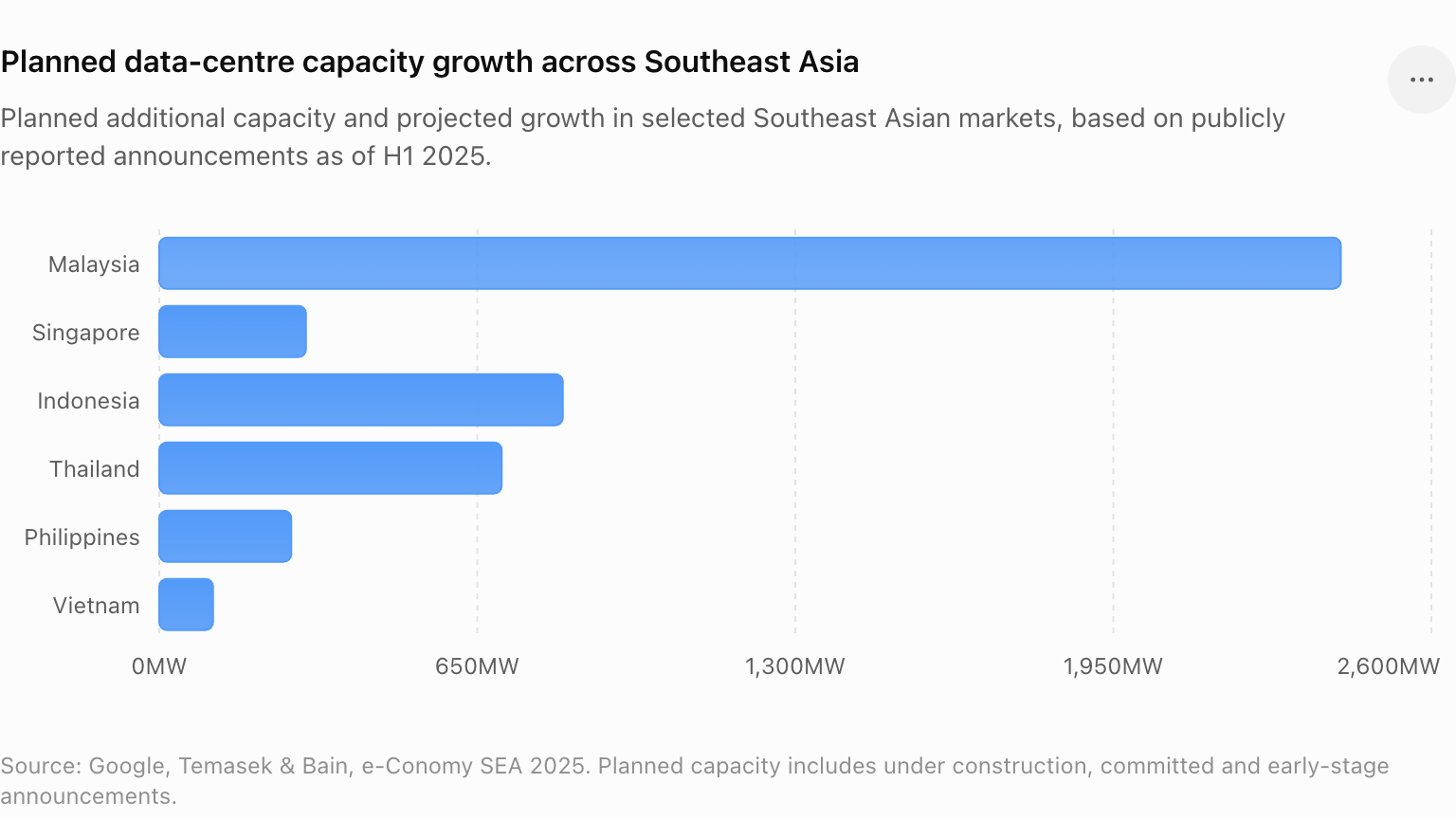
Google, Temasek and Bain & Company also reported that more than 4,600 MW of new data-centre capacity is planned across Southeast Asia, potentially increasing the region’s capacity by around 180%.
The race is heating up.
But why Southeast Asia?
Why is the data-centre boom happening in ASEAN?
There isn’t one single reason.
The region is benefiting from a combination of digital transformation, growing AI demand, strategic connectivity, investment incentives, relatively competitive costs and the diversification of global supply chains.
1. Governments are going digital
Across ASEAN, governments are investing heavily in digital transformation.
Thailand is developing its digital economy and national AI programmes. Malaysia has its MyDIGITAL strategy. Singapore continues to expand its Smart Nation programme. The Philippines has its Philippine Digital Strategy, while Vietnam is implementing its national digital transformation programme.
These policies are creating demand for cloud computing, digital government services, AI systems, cybersecurity and data storage.
ASEAN’s investment agency notes that these national strategies are increasingly being accompanied by policies covering 5G, cloud adoption, e-government, digital skills, AI and data governance.
The more governments, companies and consumers move online, the more infrastructure is required underneath them.
Every digital payment, cloud application, AI query, video stream and online transaction ultimately depends on computing and network infrastructure.
And that infrastructure needs somewhere to live.
2. AI is changing the equation
The data-centre story is no longer simply about storing data.
AI is creating a much larger demand for computing power.
Training and running AI models requires large amounts of processing capacity, which means hyperscalers and technology companies need new facilities capable of handling increasingly intensive workloads.
Southeast Asia is already seeing major investment activity as global technology companies expand their cloud and AI infrastructure in the region.
Google, Temasek and Bain reported that Southeast Asia’s planned data-centre capacity is growing significantly faster than the wider Asia-Pacific market.
This is why the data-centre industry is becoming closely connected to the AI race.
The companies building AI products need computing infrastructure.
The countries providing that infrastructure can potentially attract investment, jobs and supporting industries.
3. ASEAN’s location matters — but connectivity matters even more
Southeast Asia sits between some of the world’s largest economies like China and India and is connected to major international trade and digital routes.
But the region’s geographical advantage isn’t simply about being close to China.
Data centres need reliable international connectivity, low-latency networks, submarine cables, internet exchanges and access to large concentrations of customers.
This is particularly important for Singapore.
The city-state has long been a major regional data-centre hub, but constraints involving land, electricity and sustainability have encouraged some investment to spill into neighbouring markets.
Malaysia’s Johor region has emerged as a major beneficiary because of its proximity to Singapore while offering greater availability of land and power.
Other markets including Indonesia, Thailand, the Philippines and Vietnam are also expanding their data-centre ecosystems.
The result is something bigger than individual data centres.
A regional digital infrastructure ecosystem is beginning to form.
4. Investment incentives are attracting the industry
Data centres require enormous amounts of capital.
They also require land, electricity, water, fibre connectivity and a regulatory environment capable of supporting large-scale digital infrastructure.
That has encouraged ASEAN governments to compete for investment.
Malaysia, the Philippines, Thailand, Indonesia and Vietnam have introduced different investment facilitation measures and policies designed to attract digital infrastructure.
ASEAN’s investment agency identifies measures including foreign ownership arrangements, investment incentives, land allocation, streamlined licensing, renewable-energy access and dedicated investment facilitation.
For governments, the attraction is not only the data centre itself.
A large facility can generate demand for construction, engineering, telecommunications, electricity, cooling systems, cybersecurity and other services.
But there is one major problem: electricity
There is a catch to the AI and data-centre boom.
Data centres consume enormous amounts of electricity.
And AI is increasing the amount of computing power required.
ASEAN’s energy analysts have therefore highlighted a growing tension between digital expansion and the region’s energy and decarbonisation goals.
This means the next phase of competition may not simply be:
Who has the cheapest land?
It could increasingly become:
Who can provide reliable, affordable and cleaner electricity at scale?
That changes the game.
Countries with strong electricity grids, renewable-energy potential, reliable connectivity and investment-friendly policies could have an advantage in attracting the next generation of AI infrastructure.
The ASEAN Power Grid could also become increasingly relevant. ASEAN, together with the Asian Development Bank and World Bank Group, has been working on financing initiatives to strengthen regional electricity connectivity, including domestic grid upgrades and subsea power connections.
Where are the business opportunities?
The data-centre boom creates opportunities far beyond the companies that actually operate data centres.
Energy
Data centres need enormous and reliable electricity supplies.
This creates opportunities in:
- Renewable energy
- Solar and wind projects
- Battery storage
- Power transmission
- Grid infrastructure
- Energy management
- Power purchase agreements
- Backup power systems
Construction and engineering
A hyperscale data centre is effectively a major infrastructure project.
That creates demand for:
- Construction companies
- Electrical engineering
- Mechanical engineering
- Cooling systems
- Fire protection
- Security systems
- Building management
- Project management
Fibre and telecommunications
A data centre without high-quality connectivity is of limited value.
That creates opportunities in:
- Fibre networks
- Submarine cables
- Internet exchanges
- Telecom infrastructure
- Network security
- Low-latency connectivity
Cooling technology
Cooling is one of the most important components of data-centre operations.
As AI servers become more powerful, traditional cooling systems may not always be sufficient.
This creates opportunities in:
- Liquid cooling
- Advanced HVAC
- Energy-efficient cooling
- Thermal management
- Water-efficient cooling technologies
Cybersecurity
More data and more AI infrastructure also mean more potential security risks.
Businesses will increasingly require:
- Data-centre security
- Cloud security
- Identity management
- Network security
- Data protection
- AI security
Data-centre services
There is also a large ecosystem around operating these facilities.
Opportunities include:
- Facility management
- Maintenance
- Monitoring
- Hardware installation
- Equipment servicing
- Security
- Compliance
- Staffing and technical training
AI and cloud businesses
Perhaps the biggest opportunity sits above the infrastructure itself.
Once the computing infrastructure is available, companies can build services on top of it.
That includes:
- AI startups
- Cloud applications
- Fintech
- E-commerce
- Enterprise software
- Digital healthcare
- Gaming
- Media
- Logistics technology
- Government technology
In other words, the data centre is not the final product.
It is the infrastructure underneath an increasingly digital economy.
ASEAN’s next challenge: can the region power its AI ambitions?
The opportunity is enormous, but so are the challenges.
Data centres require electricity, land, water, connectivity and skilled workers.
If investment grows faster than power infrastructure, electricity reliability could become a constraint.
If governments focus only on attracting investment without developing renewable energy and grid capacity, the environmental cost could also become a larger issue.
And competition between ASEAN countries is intensifying.
Singapore has the established ecosystem.
Malaysia has become a major growth market.
Indonesia has a huge domestic market.
Thailand is attracting significant new investment.
The Philippines is pursuing hyperscale development.
Vietnam is building its digital infrastructure and data-centre ecosystem.
The region therefore isn’t becoming one single data-centre market.
It is becoming a collection of interconnected markets competing — and potentially cooperating — for the same wave of investment.
The bigger opportunity for ASEAN
The data-centre boom could represent something much larger than a construction cycle.
It could help ASEAN move further up the digital value chain.
Data centres can attract cloud providers.
Cloud infrastructure can attract AI companies.
AI companies can attract technology talent.
Technology investment can support new industries.
And those industries can create demand for even more digital infrastructure.
That creates a potential cycle of investment.
But the real test will be whether ASEAN can capture value beyond simply hosting servers.
The region’s long-term opportunity lies in building the entire ecosystem around them — energy, connectivity, talent, cybersecurity, cloud computing, AI applications and digital businesses.
The race for data-centre capacity has already begun.
The next question is whether Southeast Asia will simply become a place where the world’s data is stored, or whether it can become one of the places where the next generation of digital businesses is built.
For ASEAN, that may be the bigger prize.