

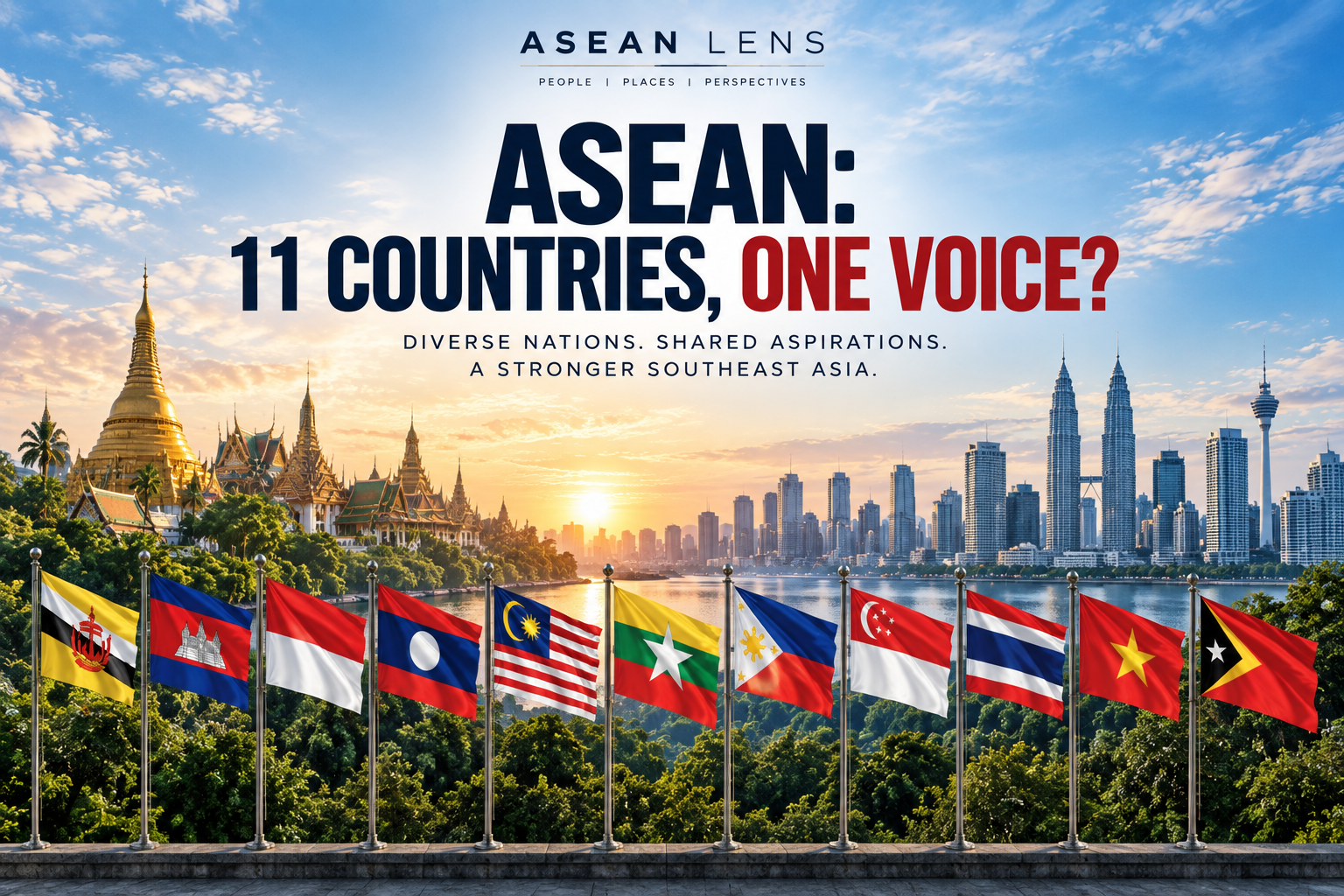
Imagine trying to get eleven countries to agree on almost anything.
Now imagine those countries have different political systems, different economies, different religions, different relationships with major powers and sometimes completely different national interests.
That is ASEAN.
The Association of Southeast Asian Nations is often described as a regional bloc, but it is very different from the European Union.
ASEAN does not have a single government.
It does not have one president making decisions for the entire region.
And it does not have a common foreign policy that every member must follow.
Instead, ASEAN is built around cooperation, consultation, and consensus.
And that is both its strength and its weakness.
How did ASEAN begin?
ASEAN was created on 8 August 1967 in Bangkok.
Indonesia, Malaysia, the Philippines, Singapore and Thailand were the five founding members.
The organisation was born during a very different Southeast Asia — a region dealing with political instability, Cold War tensions, territorial disputes and concerns about outside powers.
The basic idea was relatively simple:
Countries that had plenty of reasons to disagree needed a reason to cooperate.
Over the following decades, ASEAN expanded.
Brunei joined in 1984.
Vietnam followed in 1995.
Laos and Myanmar joined in 1997.
Cambodia joined in 1999.
And in October 2025, Timor-Leste became ASEAN’s eleventh member.
From five countries in 1967 to eleven today, ASEAN has become one of the most important regional organisations in Asia.
But getting eleven countries into the same room is easier than getting eleven countries to agree.
The ASEAN way
To understand ASEAN, you have to understand something often called the “ASEAN Way.”
It is based heavily on consultation, consensus, sovereignty and non-interference.
ASEAN’s principles emphasise respect for national sovereignty and the right of states to manage their internal affairs without outside interference. ASEAN documents also emphasise consensus-based decision-making and peaceful settlement of disputes.
At first glance, this can look frustratingly slow.
But there is a reason ASEAN developed this way.
Its members are extremely different.
Singapore is a highly developed financial and technological centre.
Laos has a very different economic structure.
Indonesia is a huge archipelagic country with a population of hundreds of millions.
Brunei is a small, wealthy energy producer.
Vietnam has a rapidly developing manufacturing economy.
Myanmar has experienced decades of military rule and political conflict.
Thailand has its own unique political history.
The differences are enormous.
ASEAN’s consensus model allows these countries to sit at the same table without requiring them to become politically identical.
But consensus has a price
The problem becomes obvious when ASEAN faces a crisis.
What happens when member states disagree?
Myanmar is perhaps the clearest recent example.
After the 2021 military takeover, ASEAN created the Five-Point Consensus and attempted to use diplomacy and dialogue to address the crisis.
But implementation has been slow, and ASEAN has struggled to produce a unified response.
The South China Sea presents another example.
ASEAN members do not all have the same interests in their relationships with China.
Some have direct maritime disputes.
Others have much stronger economic relationships with Beijing.
So getting every member to support a single strong position can be extremely difficult.
This is the paradox of ASEAN.
The organisation’s diversity is one of its greatest strengths.
But that same diversity can make collective action difficult.
ASEAN is not the European Union
This distinction is important.
People sometimes look at ASEAN and expect it to behave like the European Union.
But ASEAN was never designed that way.
The EU has institutions with significant authority over member states and a much deeper level of political and economic integration.
ASEAN is much more focused on cooperation between sovereign governments.
Its members retain considerable freedom over their foreign policy, domestic politics and economic decisions.
ASEAN is therefore less about becoming one country and more about creating a framework in which neighbouring countries can work together.
That difference explains why ASEAN can appear both powerful and powerless at the same time.
So what does ASEAN actually do?
Quite a lot.
ASEAN has built cooperation across trade, investment, tourism, education, transport, digital technology, security, health and culture.
The ASEAN Economic Community is intended to deepen economic integration.
The ASEAN Political-Security Community focuses on political and security cooperation.
The ASEAN Socio-Cultural Community covers areas including education, culture, health and social development.
Together, these form the three pillars of the ASEAN Community.
ASEAN also provides a platform for major powers to engage with Southeast Asia.
China, the United States, Japan, India, Australia, South Korea and others all participate in ASEAN-led regional forums.
That gives ASEAN something that individual member states may have less of on their own: collective diplomatic relevance.
One voice — or eleven voices?
This is where the title of this article comes in.
Can ASEAN really speak with one voice?
Sometimes, yes.
On other issues, not so easily.
ASEAN works best when its members share a broad interest.
Economic cooperation is a good example.
But when an issue directly affects the strategic or political interests of individual members, differences become much harder to overcome.
That does not necessarily mean ASEAN is broken.
It may simply mean that ASEAN was never designed to eliminate those differences.
Its purpose is to manage them.
The real achievement may be staying together
Perhaps the most interesting thing about ASEAN is not that eleven countries always agree.
They clearly do not.
The interesting thing is that countries with such different political systems, economic models and strategic interests continue to maintain a regional organisation and meet regularly to negotiate their differences.
ASEAN’s success may therefore be measured differently from that of organisations built around deeper integration.
The question is not always:
“Did ASEAN agree?”
Sometimes the more important question is:
“Did ASEAN keep talking?”
That approach can look slow.
It can look frustrating.
And in moments of crisis, it can appear inadequate.
But it has also allowed Southeast Asian countries to build a regional framework without giving up their sovereignty.
So, does ASEAN have one voice?
Not always.
Perhaps ASEAN’s real strength is that eleven very different voices have decided that it is still better to speak to each other than to speak past each other.
And in Southeast Asia, that may matter more than it first appears.