

Imagine being told to leave your home — or lose everything in it — because of something happening thousands of kilometres away, caused by people you’ll never meet. That’s not a hypothetical. For millions of people across Southeast Asia, it’s already reality. The cause is climate change, and the region didn’t create the problem it’s now paying for.
Who’s Actually Causing Climate Change?
Short answer: It depends on how you measure it. By total national emissions, China and the US lead. But per person, wealthy Western nations still emit far more than the rest of the world.
It’s easy to assume the two biggest economies—the US and China—share the blame equally. Total emissions data seems to back that up: China emits roughly 12 billion tonnes of CO2 annually and the US about 4.9 billion tonnes, together dwarfing every other country. But total emissions only tell part of the story, because China also has over four times the US population.
Look at emissions per person, and the picture flips. As of 2024, the average American emits around 13.6 tonnes of CO2 a year, and the average Canadian about 14 tonnes — compared to roughly 9.3 tonnes for the average person in China, and just 1.9 to 2.2 tonnes for the average person in India. Historically, the gap is even starker: the United States alone is responsible for about 24% of all cumulative CO2 emissions since 1850, more than any other country or bloc on Earth.
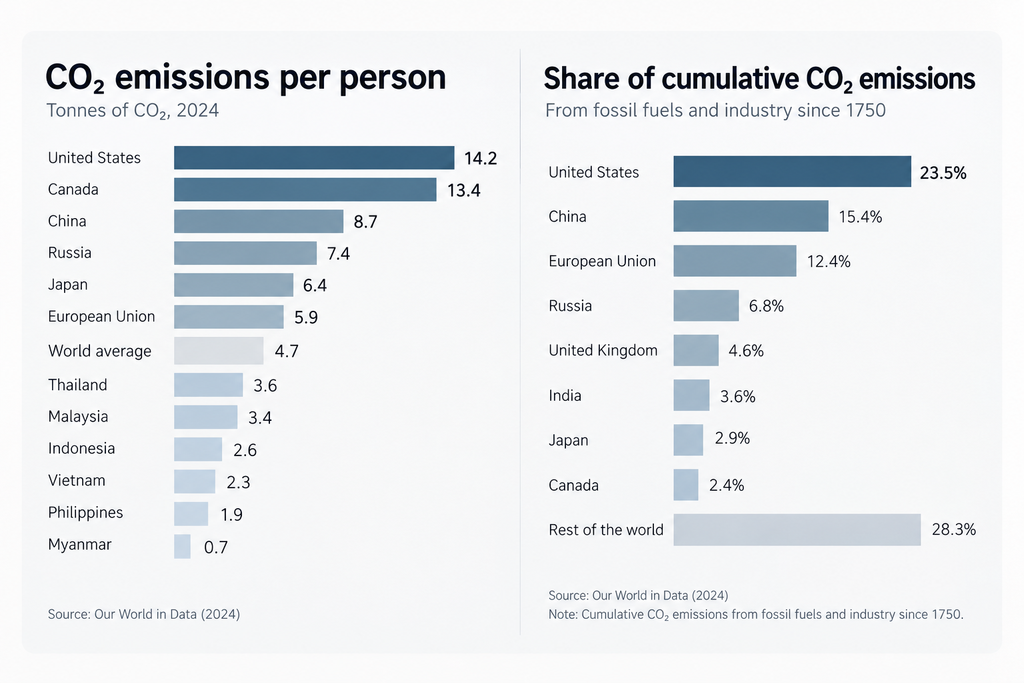
In other words, the nations with the lowest per-capita emissions today—much of Southeast Asia included—are often the ones absorbing the worst consequences.
How Is Climate Change Affecting Southeast Asia?
Short answer: Southeast Asia is one of the most disaster-exposed regions on the planet, with Myanmar, the Philippines, and Vietnam consistently ranking among the countries hit hardest by extreme weather.
Germanwatch’s Climate Risk Index, which tracks the countries most damaged by storms, floods, and heatwaves each year, tells a consistent story. In its most recent 2026 report (covering 2024), the Philippines ranked 7th, Myanmar 9th, and Vietnam 10th out of 174 countries assessed for extreme weather impact. Zoom out to the longer 1993–2022 window, and Myanmar ranks among the four most affected countries on Earth, largely due to Cyclone Nargis in 2008, one of the deadliest storms in recorded history.
The Philippines faces an average of 20 tropical cyclones every year. In 2024 alone, six typhoons struck the country within just 30 days — Gaemi, Yagi, Trami, Man-Yi, and others — a stretch researchers at World Weather Attribution linked directly to human-caused climate change, which they found had intensified average storm strength by roughly 2 m/s and boosted the likelihood of storms like Gaemi by around 30%.
Myanmar remains one of the most climate-vulnerable nations in the world, a legacy shaped heavily by Cyclone Nargis, which killed well over 100,000 people in 2008 and remains one of the deadliest natural disasters of the 21st century. Flooding and erratic monsoon patterns continue to threaten farming communities that make up much of the country’s economy.
Vietnam is increasingly exposed too, entering the global top 10 most-affected list in the 2026 index for the first time in recent years, driven by worsening flooding, coastal erosion in the Mekong Delta, and more intense storm seasons.
Nepal is asking a bigger question
Although Nepal is not part of Southeast Asia, its recent disaster shows how the climate justice debate is spreading across vulnerable parts of Asia.
After devastating floods in August 2026, Nepal called for international financial support and framed the issue as one of climate justice. The UN said Nepal contributes very little to global greenhouse-gas emissions while facing severe human and economic consequences from climate-related disasters.
Nepal’s government has also asked for grant-based support rather than simply taking on more debt to rebuild.
That raises an uncomfortable question for the rest of Asia:
If countries that contributed relatively little to climate change are paying a growing price for it, who should help pay the bill?
Southeast Asia faces a difficult choice
he region cannot simply stop developing.
Countries need factories, electricity, roads, cities, jobs and higher living standards.
At the same time, they need to make that development more resilient and less dependent on high-carbon infrastructure.
That means investing in:
- flood protection
- stronger infrastructure
- early-warning systems
- climate-resilient agriculture
- renewable energy
- better water management
- coastal protection
The challenge is that adaptation costs money, and the countries most exposed to climate risks often have fewer financial resources.
The bigger question
Climate change is often presented as a story about rising temperatures.
For Southeast Asia, it is becoming something much more immediate.
It is about whether a family can keep its home.
Whether a farmer can keep growing food.
Whether a city can survive another major flood, as in the recent flood in Bangkok, Thailand.
Whether a country can rebuild without falling deeper into debt.
Southeast Asia did not create the climate crisis alone. But it will have to live with its consequences.