

Trump, Xi and ASEAN: What the US-China Rivalry Means for Southeast Asia
For ASEAN, what happens between Washington and Beijing matters far beyond diplomacy.
The Diplomat
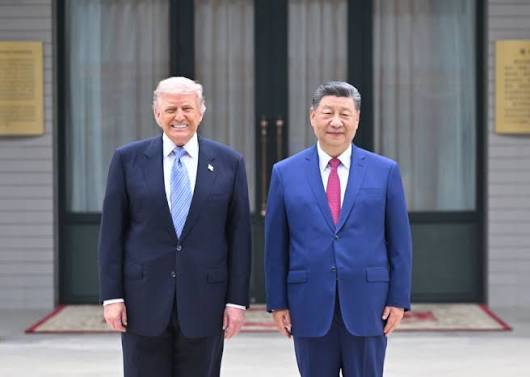
Southeast Asia has spent years trying to avoid choosing between the United States and China.
That balancing act is becoming harder.
As U.S. President Donald Trump prepares to welcome Chinese President Xi Jinping to Washington on September 24, 2026, the world’s two largest economies are once again trying to manage their rivalry through direct negotiations.
For ASEAN, what happens between Washington and Beijing matters far beyond diplomacy.
It can affect trade, factories, investment, technology, supply chains, shipping routes and the strategic choices available to Southeast Asian countries.
The question for ASEAN is not simply whether Trump and Xi can improve their relationship.
It is what happens to Southeast Asia if they do — and what happens if they don’t.
THE TWO GIANTS ARE ALREADY DEEPLY CONNECTED TO ASEAN
China is ASEAN’s largest trading partner, a position it has held since 2009.
ASEAN-China merchandise trade reached about US$772.4 billion in 2024, representing roughly one-fifth of ASEAN’s total trade. Chinese investment in ASEAN reached US$19.3 billion that year.
The United States is also deeply embedded in the regional economy.
ASEAN recorded US$453.19 billion in two-way trade with the United States in 2024, making the U.S. its second-largest trading partner. The U.S. was also ASEAN’s largest external source of foreign direct investment, with US$42.13 billion in inflows in 2024.
In other words, ASEAN does not have the luxury of treating Washington and Beijing as distant powers.
Both are already part of the region’s economic structure.
THE TRUMP EFFECT: TRADE HAS BECOME MORE POLITICAL
Under Trump, trade has increasingly become a strategic issue rather than simply an economic one.
U.S. tariff policies and scrutiny of Chinese content have encouraged companies to reconsider where they manufacture and source products.
That creates both opportunities and risks for Southeast Asia.
Countries such as Vietnam, Thailand, Malaysia and Indonesia have become important parts of regional manufacturing and supply chains.
But there is another side to the story.
If Chinese companies redirect more exports or production toward Southeast Asia, regional economies can benefit from investment and manufacturing activity while also facing greater competition from Chinese goods.
A June 2026 analysis from the U.S. Chamber of Commerce described Southeast Asia as facing a difficult position: China remains a major source of imports while the United States remains an important export market, creating pressure on governments and companies to navigate both relationships simultaneously.
ASEAN therefore has to manage a delicate economic equation.
It wants Chinese investment and access to the Chinese market.
It also wants continued access to the American market and investment.
Neither relationship can easily be replaced by the other.
XI’S CHINA: ECONOMIC POWER WITH STRATEGIC WEIGHT
China’s influence in Southeast Asia is not based only on trade.
Infrastructure, manufacturing, technology, tourism, investment and regional connectivity have created a broad network of economic relationships.
ASEAN and China are also strengthening their institutional relationship. In September 2026, ASEAN Secretary-General Kao Kim Hourn travelled to Beijing for meetings with senior Chinese officials and participated in events marking five years of the ASEAN-China Comprehensive Strategic Partnership.
At the same time, ASEAN and China are working on the implementation of the ASEAN-China Free Trade Area 3.0 upgrade and broader economic cooperation.
This gives Beijing significant economic weight in Southeast Asia.
But economics is only part of the picture.
The South China Sea remains one of the region’s most sensitive security issues, particularly for countries with competing maritime claims.
This creates a fundamental tension for ASEAN.
China can be an essential economic partner while simultaneously being a source of strategic concern for some ASEAN members.
THEN THERE IS TRUMP’S AMERICA
The United States remains an important economic and security partner for Southeast Asia.
But Trump’s approach has created uncertainty about how Washington will engage with the region over the longer term.
That uncertainty matters because ASEAN countries have traditionally tried to maintain relationships with both major powers rather than becoming dependent on one.
A 2026 survey by the ISEAS–Yusof Ishak Institute found that Southeast Asian respondents continued to favour a balanced approach, even as perceptions of both China and the United States remained complicated.
For ASEAN governments, the objective is therefore not necessarily to choose Washington over Beijing — or Beijing over Washington.
It is to preserve room to make their own decisions.
WHAT IF TRUMP AND XI REACH A DEAL?
This is where things become particularly interesting for ASEAN.
A more stable U.S.-China relationship could reduce some of the economic uncertainty facing the region.
Lower trade tensions could make global supply chains more predictable.
But there could also be complications.
If Washington and Beijing reach agreements that benefit primarily the two largest economies, ASEAN countries could find themselves adapting to decisions made elsewhere.
This is one reason ASEAN’s economic diversification efforts matter.
The region has been building broader arrangements such as RCEP while simultaneously maintaining separate relationships with the United States, China, Japan, South Korea, India, Australia and others.
ASEAN wants to avoid becoming dependent on a single economic or strategic partner.
THE OPPOSITE SCENARIO COULD BE MORE DIFFICULT
If Trump and Xi fail to manage their differences, Southeast Asia could face another period of uncertainty.
Tariffs could affect regional exporters.
Technology restrictions could complicate semiconductor and digital supply chains.
Competition over critical minerals could affect manufacturing.
And growing U.S.-China strategic rivalry could place additional pressure on ASEAN countries to take positions they would rather avoid.
The South China Sea could become even more complicated if economic competition is accompanied by increased strategic competition.
This is where ASEAN’s traditional approach of dialogue and regional institutions becomes important.
ASEAN cannot control what Washington and Beijing decide.
But it can try to keep Southeast Asia from becoming merely an arena in which those decisions are played out.
ASEAN’S BIGGEST ASSET MAY BE ITS ROOM TO MANOEUVRE
The temptation is to describe Southeast Asia as being “caught between” America and China.
But that description can be misleading.
ASEAN countries are not simply passive players.
They trade with China.
They trade with the United States.
They attract investment from both.
They participate in RCEP.
They cooperate with Japan, South Korea, India, Australia and Europe.
And they continue to use ASEAN-led forums to bring competing powers into the same diplomatic space.
The challenge is maintaining that flexibility as competition between Washington and Beijing becomes more complicated.
THE REAL TEST FOR ASEAN
The Trump-Xi relationship will continue to change.
There may be periods of confrontation, negotiation and temporary cooperation.
But Southeast Asia cannot afford to build its future around predicting which direction the relationship will take next.
Its bigger challenge is building enough economic and diplomatic resilience to handle either outcome.
If Trump and Xi improve relations, ASEAN will have to ensure that its interests remain part of the conversation.
If tensions increase, ASEAN will have to protect trade, investment and regional stability from the effects of great-power competition.
Either way, the region’s strategy is likely to remain familiar:
Work with China.
Work with America.
Work with everyone else.
And, as far as possible, avoid having to choose.
For ASEAN, the question is no longer whether the United States and China will shape Southeast Asia.
They already do.
The question is how much influence Southeast Asia can retain over its own future.